Moments and L-moments
In addition to MLE and MCMC, pyextremes supports
two moment-based fitting methods: the Method of Moments (MOM) and L-moments
(Lmoments). Both estimate distribution parameters by matching summary statistics
of the distribution to those of the observed extreme values, instead of maximizing
the likelihood.
Method of Moments
The Method of Moments
finds distribution parameters for which the theoretical moments of the distribution
(mean, variance, skewness, etc.) are equal to the sample moments
of the extreme values. A distribution with \(k\) free parameters is fitted by matching
its first \(k\) moments. pyextremes uses the fit method of
scipy.stats.rv_continuous
with method="mm". Like MLE, it works with any continuous distribution
and supports fixing distribution parameters.
Note
You can get the data variable referenced above by running the following code:
import pandas as pd

data = pd.read_csv(
    "battery_wl.csv",
    index_col=0,
    parse_dates=True,
).squeeze()
data = (
    data
    .sort_index(ascending=True)
    .astype(float)
    .dropna()
    .loc[pd.to_datetime("1925"):]
)
data = (
    data
    - (data.index.array - pd.to_datetime("1992"))
    / pd.to_timedelta("365.2425D")
    * 2.87e-3
)
"battery_wl.csv"
can be downloaded here.
Heavy tails
Moments of heavy-tailed distributions may not exist. For example,
the skewness of the GEVD is infinite for \(\xi \geq 1/3\) and the variance
is infinite for \(\xi \geq 1/2\). Even when the true distribution has finite moments,
the optimizer may reach such parameter values and fail. This is what happens
when fitting genextreme to the Battery annual maxima, which are heavy-tailed
(\(\xi \approx 0.27\)):
ValueError: Method of moments encountered a non-finite distribution moment and
cannot continue. Consider trying method='MLE'.
Because rare events are governed by the tail of the distribution, MOM is
generally not recommended for EVA, except for distributions with
no shape parameter (e.g. gumbel_r or expon), where it is simple and robust.
L-moments
L-moments are analogues of
conventional moments calculated as linear combinations of ordered data values.
Compared with conventional moments, they exist whenever the mean exists,
are less sensitive to outliers, and produce reliable estimates from small samples,
which has made them a standard tool in hydrology and regional frequency
analysis (Hosking, 1990). pyextremes uses the
lmoments3 package, which must be
installed separately:
Unlike MOM, L-moments handle the heavy-tailed annual maxima without issues and produce parameters very close to MLE:
The Lmoments model has the following limitations:
- Only the following distributions are supported (referred to by their
scipy.statsnames and passed as strings):expon,gamma,genextreme,genlogistic,gennorm,genpareto,gumbel_r,kappa4,norm,pearson3, andweibull_min. - Distribution parameters cannot be fixed. Because of this,
EVAdoesn't fix the location parameter ofgenparetoandexpondistributions at the threshold (see Distributions) and the location parameter is fitted instead. For example, for the POT extremes above a threshold of 1.5 m the fitted location is 1.506 m.
Comparison
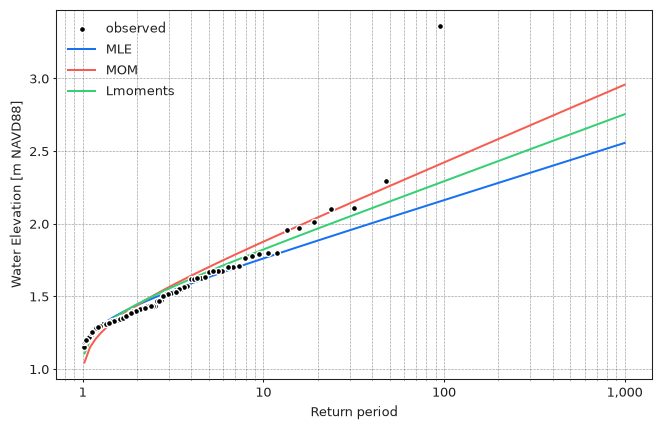
Comparing the fitting methods is a good way to check how sensitive the results are
to the choice of method. The figure below shows the Gumbel distribution fitted to the
annual maxima using MLE, MOM, and L-moments
(produced using the same code as the figures in
Distributions,
with fit_model(model=..., distribution="gumbel_r")):
| Distribution | Model | 100-year water level, m |
|---|---|---|
genextreme |
MLE |
2.671 |
genextreme |
Lmoments |
2.658 |
genextreme |
MOM |
fails (see above) |
gumbel_r |
MLE |
2.161 |
gumbel_r |
Lmoments |
2.292 |
gumbel_r |
MOM |
2.421 |
When the distribution describes the data well (genextreme), different methods
agree closely. When it doesn't (gumbel_r can't represent the heavy tail of these
data), the methods disagree, with MOM being the most influenced by the largest
observations. A large disagreement between methods is a sign that the
selected distribution may not be appropriate.
Info
AIC should not be used to compare models fitted using different methods. MLE maximizes the likelihood by definition, so it always has the smallest AIC for a given distribution. Use AIC to compare distributions fitted using the same method (see Distributions).
Confidence intervals for both MOM and Lmoments are estimated using bootstrap
resampling with the n_samples argument, as described in
Maximum Likelihood.